Interview about my award-winning book Mahabhareata: The Eternal Quest with Professor Fici at — https://www.youtube.com/watch?v=nBccYXmtCUQ&fbclid=IwAR3qqUiUgF5bzlLkrG8YbfEeYmS_wb0jE_PuN_2AQnOQm5xtlvtQx53Ravk

India's Ancient Epic
Interview about my award-winning book Mahabhareata: The Eternal Quest with Professor Fici at — https://www.youtube.com/watch?v=nBccYXmtCUQ&fbclid=IwAR3qqUiUgF5bzlLkrG8YbfEeYmS_wb0jE_PuN_2AQnOQm5xtlvtQx53Ravk
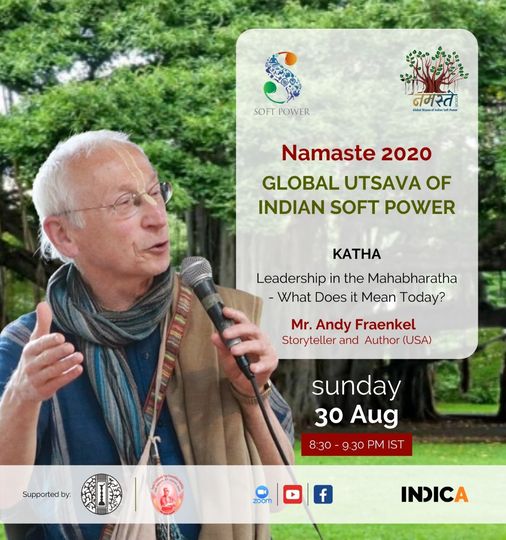
Below are my two sessions for Namaste 2020 which were shown live on August 30th. The first, Word Power is a panel discussion I participated in. The second is my Katha session on Mahabharata and Leadership. I hope you enjoy them.
https://www.softpowermag.com/word-power-namaste-2020/
https://www.softpowermag.com/katha-leadership-in-the-mahabharatha-what-does-it-mean-today/


ANDY: You say, “The concerns addressed in the Mahabharata are the concerns of humanity.” This is a very profound statement. This applies to both East and West. I would say that most people want to live a peaceful and principled and meaningful life. But they are often confused. They don’t know how to do it. Even in the beginning of Bhagavad Gita, Arjuna is confused. And like Arjuna, we have to ask the right questions from Krishna or His devotees, and then we can do the right thing. Otherwise, all over the world, ideals, morals and values are being diminished. We live in a time characterized by rampant greed, fear, and untruthfulness.
College professors here in the USA tell me that many students arrive in college ill prepared. Many students can’t write a decent essay. They are not critical thinkers. The educational system is failing the students. And when they get out of college students are under mounds of debt. Again, there is a lack of leadership to address these issues. This was very important for me in writing the Mahabharata – to convey the principles of Dharma and give examples of good leadership. It’s all there in the Mahabharata.
So our Krishna Consciousness Movement is an educational movement, to help people get trained in the Dharma, to develop good character, good leadership qualities, and to understand what the real goal of life is. It’s like the sun. The sun is not for Indians, Chinese or Americans. The sun is shining everywhere for all people. So the Mahabharata and Ramayana are classic literatures for all the people of the world.
Vedic literatures offer a holistic solution: to live a simple, uncomplicated, peaceful life, based on the principles of Dharma. Then, just like Hanuman, we can be of service to the Lord and to the wellbeing of the Earth through our efforts, our intelligence and our individual propensities.
February 7th is the release date for my newest offering – Hanuman’s Quest – the Book. There are three HANUMAN pages on this site for more details.  May all be well
“. . . the original Mahabharata is an epic in every sense of the word. . The new volume is a condensing of this monumental text that keeps its heroic figures, mystical deeds, and  philosophies on justice, honor, and perseverance at the fore-
front while relating the story with a lighter pace and a visually rich prose style that recalls Western works like The Lord of the Rings trilogy. . . A useful glossary, map, and an outline of the  Vedic worldview are included. . . many of the concepts, from Brahmins to mantras, are organically introduced. . . There’s a surprising amount of humor in the story, with effective modern flourishes. . . An inherently approachable tale despite the vastness of the Indian mythology it taps into.”        Kirkus Reviews
 The Mahabharata Project